
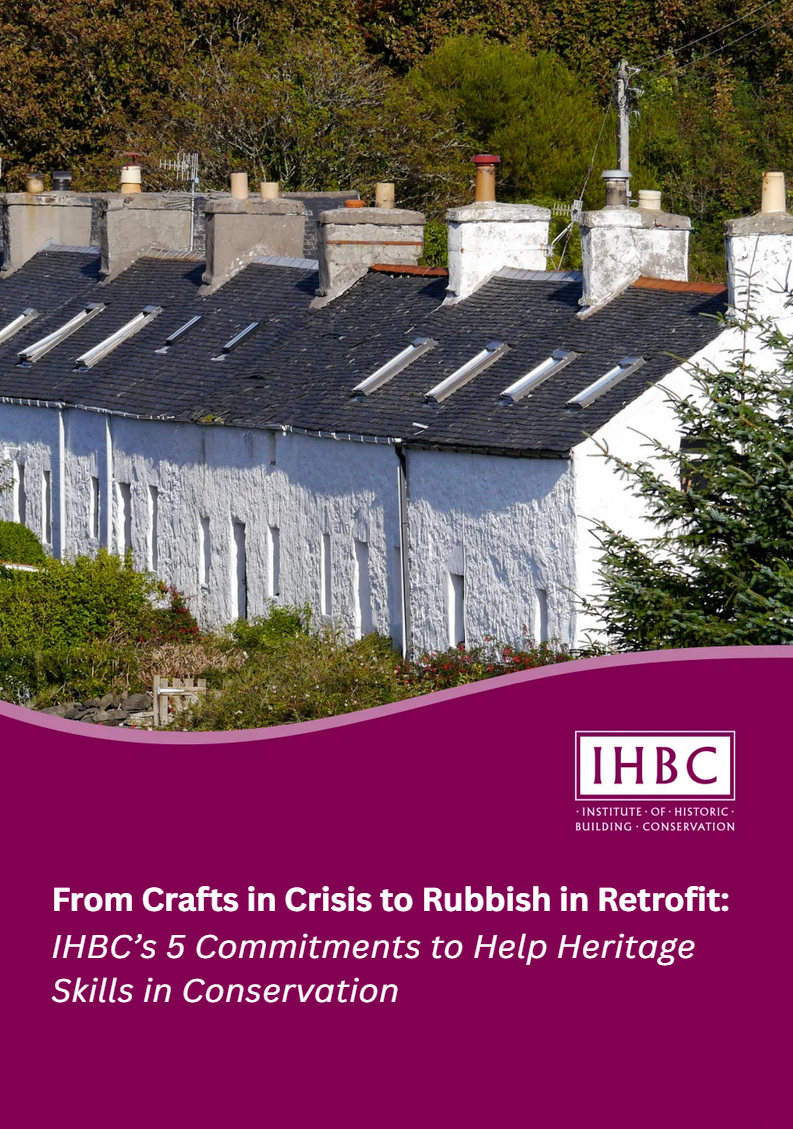
The IHBC has welcomed the conclusions of the Parliamentary Culture, Media and Sport Committee’s (CMS) inquiry into ‘Protecting built heritage’ – that the ‘deterioration of heritage… represents a major missed opportunity…’ – especially its echo of heritage wastage in the IHBC’s own ‘From Crafts in Crisis to Rubbish in Retrofit’ report and 5 Commitments.
IHBC Director Sean O’Reilly said ‘We are delighted that this key Parliamentary Committee inquiry has brought a spotlight to one of the most vital – and most overlooked – agendas for the 21st Century: the ‘missed opportunity’ of our mis-managed and much maligned built and historic environment’.
‘As well as reflecting many of the IHBC’s expert contributions to the Inquiry, the Committee’s conclusions also capture the spirit – and frustration – of the IHBC’s ongoing Parliamentary advocacy on these issues, as represented by our ‘From Crafts in Crisis to Rubbish in Retrofit’ initiative.’
The (CMS) Committee writes:
… Built heritage plays a vital role in the United Kingdom’s economy, identity and community life. Historic buildings contribute to local pride, tourism, housing supply and social cohesion. However, despite the value of this contribution, many heritage assets are now under significant and increasing strain from financial pressures, workforce shortages and a planning system that is not aligned with the long-term needs of the sector.
Evidence suggests that up to 670,000 homes could be created through the reuse of vacant or under-used historic buildings. However, this potential remains under-realised. Reuse is not treated as a priority within policy or funding frameworks. International examples, including Italy’s €1 homes scheme and renovation tax incentives, demonstrate how targeted interventions can bring vacant heritage assets back into productive use, support housing delivery and revitalise communities. We call on the government to adopt a clear ‘reuse-first’ approach, embedding this principle in policy across departments and developing a UK-appropriate heritage-to-housing scheme that draws on lessons from overseas.
The sector also faces a combination of financial and structural challenges that threaten the long-term sustainability of heritage assets. We heard that funding is fragmented, short-term and heavily focused on capital projects, offering limited support for early-stage development or ongoing maintenance. Place-based approaches can also help align funding with local need and strengthen community partnerships, but without adequate capacity and accessible funding they risk being unevenly realised.
Recent changes to support schemes, including the replacement of the Listed Places of Worship Grant Scheme with the Places of Worship Renewal Fund, represent a significant shift in approach. While directing funds towards areas of socio-economic need has merit, reliance on area-based indicators risks disadvantaging places of worship of high historic and architectural significance outside these areas and could overlook the wider community value and reach of such sites. Meanwhile, the current VAT regime discourages repair and reuse by making it more expensive than new construction. Without immediate attention, these pressures could limit investment and support for heritage assets.
Workforce and capacity constraints present a growing risk to the sector. We heard evidence of acute shortages in specialist skills, declining conservation expertise within local authorities and increasing reliance on volunteers. Without a coordinated approach to training, apprenticeships and workforce development, these pressures will continue to undermine the sector’s ability to maintain heritage assets. We therefore call for targeted action to strengthen skills pipelines, expand training opportunities and better support volunteer-led organisations.
Across government we found a lack of strategic oversight, consistent data and effective accountability in the management of heritage assets. Publicly owned historic buildings are at risk of deterioration, while responsibilities are spread across departments without clear coordination or enforcement. The government must lead by example and public bodies should be required to actively manage, maintain and where appropriate, reuse their heritage assets. There should be both incentives for good stewardship and penalties where departments fail to meet minimum standards and allow assets to fall into avoidable disrepair. The planning system is widely perceived as complex, inconsistent and slow, discouraging heritage investment. Although recent reforms are welcome, further action is needed to ensure that planning policy actively supports reuse, energy efficiency and long-term conservation.
Overall, while the UK’s built heritage has immense social, cultural and economic value, the current policy and funding landscape does not adequately support its protection or potential. Change is urgently needed to secure the long-term future of the historic environment and unlock its full potential.
…
…
Our report
… 3. Our report is structured around the key challenges and opportunities we identified throughout the inquiry. The chapters explore how the potential of built heritage can be unlocked; the financial framework; consideration of the government’s role in managing the public estate; workforce and skills challenges; and finally, an evaluation of impact of the planning system on efforts to protect and make better use of our built heritage.
Box 1: Glossary of frequently used terms
Adaptive reuse – The process of repurposing historic buildings for new uses while retaining their architectural and heritage significance.
Conservation – The process of managing change to historic buildings and sites in a way that sustains their significance.
Heritage at risk / ‘at risk’ assets – Historic buildings, sites or structures that are vulnerable to loss or damage through neglect, decay or inappropriate development.
Listed building consent – The statutory permission required for works that affect the character or historic significance of a listed building, typically granted by local planning authorities.
Managed decline – A situation in which buildings are allowed to deteriorate over time, often due to a lack of funding, capacity or viable use, until intervention becomes difficult or no longer feasible.
Retrofit – The process of upgrading existing buildings to improve energy efficiency, functionality or performance, while retaining as much of the original structure and fabric as possible.
…
8.Conclusion
The deterioration of heritage assets represents a major missed opportunity. Their significant potential to support economic growth and tourism is being systematically constrained by a combination of financial, structural and policy pressures. Without a more coherent and proactive approach, increasing numbers of historic buildings will fall into disuse or managed decline, representing a loss not only to the historic environment but to growth and regeneration. The government must take sustained action to prioritise active use and remove the structural barriers that continue to hold the sector back….
Download the Report [PDF, 664 KB]
See more IHBC background HERE and


