
The Victorian Society’s President Griff Rhys Jones returned to the Today programme for the fourth year in a row to unveil its latest Top Ten Endangered Buildings 2026.
The Victorian Society writes:
… Together, they tell a powerful story about the buildings that shaped modern Britain, and the growing threats they now face. Despite their historic and architectural importance, many remain vacant, underused, or trapped in cycles of neglect, with uncertain futures and no clear plans for repair or reuse….
…Top Ten Endangered Buildings 2026 (in no particular order)
Hackney Borough Disinfecting Station, London
Grade II, Gordon and Gunton, 1901
On the eastern boundary of this London borough is a remarkable survivor. Between a waste depot and an electricity substation lies the only remaining purpose-built municipal disinfecting station in England. A sympathetic buyer must be found.
Tees Transporter Bridge, Stockton-on-Tees/Middlesbrough
Engineer: G.C. Imbault, constructed by Sir William Arrol and Co Ltd
The Tees Transporter Bridge has been closed since 2019 owing to safety concerns about the stresses the bridge is under. The issue is the funding required to restore this much-loved structure, which hinges on whether it is considered as heritage or as transport infrastructure, allowing different public funds to support its repair.
Read more
New Market Buildings, Bridgnorth
Grade II, Robert Griffiths, 1855-1859
This striking polychromatic Italianate market hall is an impressive survival of a high-status nineteenth-century commercial building. Nearby Shrewsbury and Ludlow have both already lost their market halls. The owners received planning permission in 2014 for conversion into a hotel. However, nothing came of this proposal, and the building has continued to decay to the dismay of both local residents and the council alike.
Read more
Former Strand Railway Station and Railwaymen’s Club, Barrow-in-Furness Grade II, E. G. Paley, 1863
This was Barrow’s first station, built during rapid technological change as the village grew into an industrial port. It soon became outdated, and in 1882 Barrow Central opened to allow through trains. The original dockside station was then used for goods and as a reading room for the Furness Railway employees. The Railwaymen’s Club operated there until 2008, closing after a 101-year history. Now owned by an absentee landlord, the building is decaying and in need of restoration and a new purpose.
Read more
Faenol Mausoleum, Pentir, Nr Bangor
Grade II, Henry Kennedy, late 1870s
Off the Wales Coast Path is what at first glance appears to be a romantic folly. The decaying building is in fact a Mausoleum listed as a fine, rare Welsh example. The site has suffered vandalism over the years, graffiti has appeared and the stained glass windows have been damaged. The mausoleum was built by the landowners of the Faenol Estate. This historic building needs restoration to save it from decay and abuse.
Oakes School, Huddersfield
Grade II, Charles Fowler, 1873, extended by Ben Stocks, 1885
These large, derelict buildings stand in a well-kept area of surviving Victorian architecture. After closing soon after 1970, the former school was used for housing and later as a care home, which also closed. Since then, it has steadily decayed, with only sporadic attempts to repair damage. Despite repeated appeals from Victorian Society members and the local civic society, Kirklees Council has not required the owner to maintain this listed building.
Parndon Hall, Harlow
Grade II, Architect: Possibly Joseph Clarke, 1867
The hall was built as a family home by Loftus Arkwright, great-grandson of Sir Richard Arkwright. It later passed through various public uses before being acquired by the Princess Alexandra Hospital after a period under threat of demolition. The interiors are covered by unique painted decoration by Elizabeth Arkwright, Loftus’s wife. Despite roof repairs after flooding, it is now used only for storage, and both the building and its artwork are deteriorating. A sensitive, sustainable future is needed for this important part of Harlow’s pre-New Town heritage.
St Michael’s Cemetery Chapel, Sheffield
Grade II, Charles Hadfield, 1898
Sheffield’s City Cemetery has already lost one of its Victorian chapels; this Roman Catholic mortuary chapel remains but is in council ownership. Funded by the Catholic Duke of Norfolk, it has never belonged to the Church. A 2018 specialist report found it unsafe, with a badly deteriorating roof and vegetation inside. Despite appeals, the building continues to decay, with neither responsible body taking effective action.
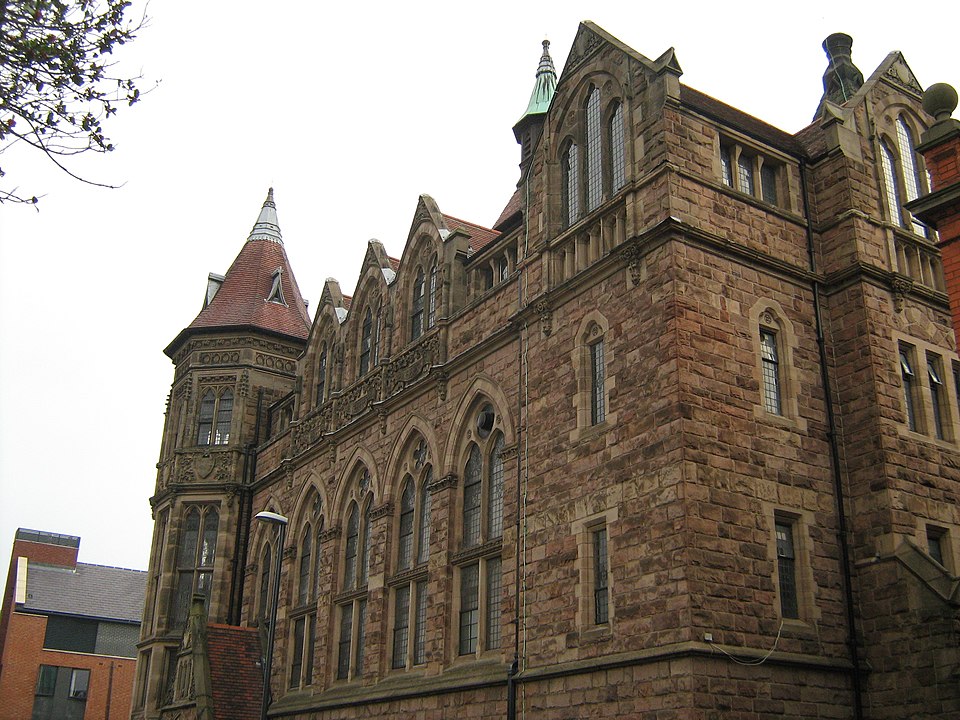
Derby School of Art, Derby
Grade II*, F.W. Waller, 1876 with additions 1899
Historic England’s list entry for this arresting building describes it as ‘a notable essay in Gothic style.’ It was originally the Central School of Art, later home to the Metro Arthouse cinema and then a rehearsal space for Derby Theatre. In August 2021 the building was sold to a university based in Georgia in the Caucasus region. The building appears never to have been subsequently occupied.
Former Library and Mechanics Institute, Devonport
Grade II, A, Norman, 1843-44
One of Plymouth’s most historic neighbourhoods is home to this decaying, partly burnt-out building known locally as the Pot Black Building, once a snooker hall in the 1980s. Originally built as a Mechanics’ Institute, it later served as a library and DVLA offices. After the Council enforced a sale in 2015, plans to convert it into apartments and a commercial unit were never realised. The building now stands empty awaiting redevelopment.


,_Green_Lane,_Derby.jpg)