
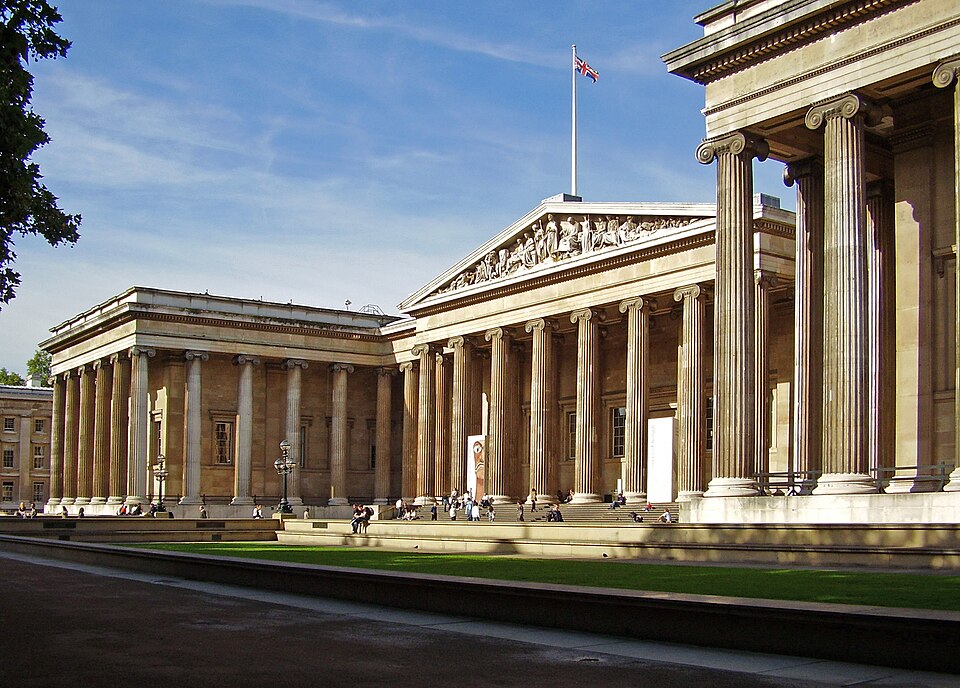
image for illustration: British Museum from NE, Ham, CC BY-SA 3.0, via Wikimedia Commons
Launching the Multiscale Heritage X-ray Imaging Centre Arts and Humanities Research Council (RICHeS) Investment -Enabling access to a suite of advanced imaging and analysis technologies at the British Museum
RICHeS writes:
The Multiscale Heritage X-ray Imaging Centre RICHeS-funded investment at the British Museum is now open for access. Supported by investment from RICHeS, the Centre brings together a suite of advanced imaging and analysis technologies, expanding the British Museum’s existing X-ray imaging capabilities and creating new opportunities for heritage research across the UK. This investment has introduced a state-of-the-art micro-CT scanner, high-performance image processing workstations, and dedicated staff expertise to support researchers in accessing and interpreting complex X-ray datasets. These new capabilities complement the British Museum’s existing large-scale, high-energy X-radiography facility, creating a broad imaging resource capable of studying objects across a wide range of sizes and materials. As new collaborations develop, the Centre will continue to expand the role of X-ray imaging in heritage research, conservation and the understanding of collections, helping to reveal new information about cultural objects while preserving them for future generations.
New Micro-CT capabilities
Micro-CT (micro-computed tomography) is a high-resolution 3D X-ray imaging technique. The newly RICHeS funded TESCAN CoreTOM micro-CT scanner was installed and commissioned at the British Museum between late 2025 and early 2026. During this period, facility staff undertook training using collection objects, developing new workflows and exploring the full potential of the system.
The scanner provides significantly enhanced spatial resolution compared with the existing facility, allowing researchers to visualise fine details such as small cracks, internal structures and micro-features within a range of materials. The CoreTOM also offers flexibility to adjust the vertical position of both the X-ray source and detector. This enables larger objects to be scanned in overlapping sections along their length and reconstructed into a single high-resolution tomographic dataset. The latest advances in X-ray imaging technology also enable faster data acquisition while maintaining high image quality, improving the efficiency and accessibility of micro-CT scanning for research projects.
Alongside the scanner, the investment has provided two high-performance image-processing workstations equipped with the latest versions of VGStudio MAX for advanced visualisation, segmentation and analysis. With increasingly large and complex datasets being generated, these resources are essential for obtaining the maximum scientific value from each project.
Celebrating scientific collaborations
In June, the British Museum and RICHeS hosted an event for colleagues from the UKRI Arts and Humanities Research Council (AHRC), the UKRI Science and Technology Facilities Council (STFC) and the Steering Committee of the Institute Laue-Langevin (ILL), a multidisciplinary neutron research facility based in France. There were 35 attendees from 13 European countries representing other funding bodies, government ministries, universities, ILL management and staff. Presentations from AHRC and British Museum colleagues included an introduction to the new Multiscale X-ray Imaging Centre, emphasising the impact of previous collaborations between the British Museum and STFC and future research potential. Attendees also enjoyed a tour showcasing ongoing scientific research into the British Museum’s collection from animal mummies to the Lewis chess pieces.
This event demonstrated how heritage science can unlock new insights into cultural heritage through cutting-edge technology and interdisciplinary research. By bringing together researchers, funders and institutional leaders from across Europe, it highlighted the critical role of international partnerships and the visit provided participants with access to the British Museum’s research infrastructure and the staff driving innovation across collections research, conservation and curation.
Supporting access to heritage science infrastructure
RICHeS investment has also enabled the creation of a dedicated X-ray Imaging Access Manager role, increasing the Centre’s capacity to support external collaborations and facilitate access to the X-ray imaging facilities. The role works alongside imaging specialists, conservators, curators and researchers across the British Museum to help develop projects and ensure that advanced imaging techniques can be effectively applied to a wide range of heritage questions.
The Centre is excited to lead two successful RICHeS Access Fund projects during the summer and autumn months, and look forward to welcoming new collaborators through the Second Call of the RICHeS Access Fund, which opens in September. Researchers are encouraged to discuss potential projects with the Centre, whether they involve individual objects, larger collections or the development of innovative approaches to X-ray imaging within heritage science. The team is keen to support new applications of imaging technology across the UK heritage sector.
For information about available services and access opportunities, visit the Heritage Science Data Service (HSDS) Catalogue of Services.


