
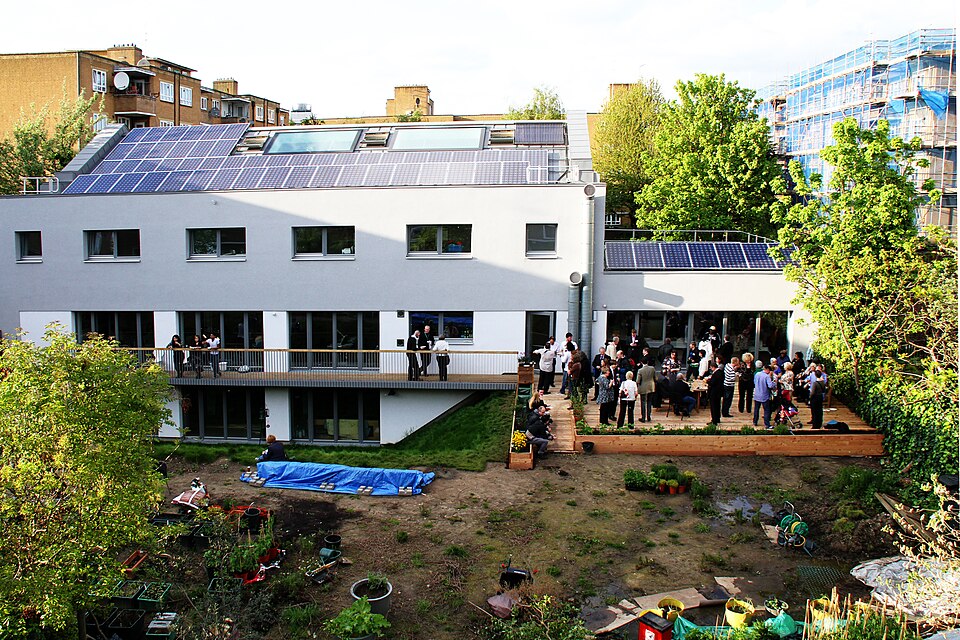
image: Mayville Community Centre, Justin Bere, CC BY-SA 4.0 via Wikimedia Commons
The IHBC has welcomed the new Heritage Counts research from Historic England (HE) on ‘Retrofitting Traditional Buildings: Embodied Carbon Payback Times’.
IHBC Chair David McDonald said: ‘Historic England’s research tackles the difficult topic of ’embodied carbon emissions’ and the effect of different retrofit approaches to a variety of domestic properties.’
‘Its conclusion that the embodied carbon costs of retrofit are paid off through operational savings within a relatively short time is a useful, contribution to the climate change debate’.
HE writes:
Research undertaken by Okana, commissioned by Historic England, looking into the different retrofit options for several types of traditional buildings (archetypical examples). The study found that the carbon used to make and install retrofit materials is paid back quickly through the carbon savings that they deliver.
Introduction
In recent years, significant efforts have been made to understand and reduce operational carbon emissions from the built environment, which is the UK’s second highest carbon emitting sector (CCC, 2025). However, there are growing calls to address a previously overlooked but critical source of carbon emissions from the built environment – the so-called embodied carbon emissions…. According to the UK Green Building Council (UKGBC 2021), embodied emissions account for around 20% of all building-related emissions. These emissions must be addressed if the UK is to successfully decarbonise the built environment.
… Retrofitting… offers a means to significantly reduce operational emissions. Yet retrofit measures come with their own embodied carbon cost. This raises a critical question – Are embodied carbon costs outweighed by operational savings over a Reference Study Period (RSP)…, once maintenance cycles, component replacement, and energy system decarbonisation are considered?
This study quantifies the embodied carbon associated with two types of retrofit options or packages — low impact and high impact — across five historic domestic building archetypes. These packages and archetypes were drawn from a 2020 Historic England–commissioned study that modelled operational carbon savings (UWE, 2020). Even allowing for uncertainty and variability in embodied carbon assessments (see below for an overview of research caveats), all embodied carbon costs were paid off through operational savings within a reasonable timeframe….’
Okana [said] ‘For the types of buildings and interventions considered here, embodied carbon considerations should offer no significant impediment to the case for retrofit.’
Embodied carbon by retrofit package, measure and lifecycle stage
The Okana research analysed the carbon footprints of retrofit packages across five traditional building archetypes, representing approximately 74% of England’s pre-1919 housing stock:
- Pre-Victorian Detached (pre-1850)
- Georgian Terrace Large (pre-1850)
- Victorian/Edwardian Terrace Medium (1850-1918)
- Victorian/Edwardian Semi (1850-1918)
- Victorian/Edwardian Terrace Small (1850-1918)
Each archetype received a package of low-impact retrofit measures and a package of high-impact retrofit measures.
Key findings
- Low impact packages have smaller embodied carbon footprints, as expected.
- The differences in emissions between low and high impact retrofit packages are modest for Archetypes 3, 4, and 5 (rising by only 5%, 12%, and 4% respectively).
- For Archetypes 1 and 2 (Pre-Victorian Detached and Large Georgian Terrace, both built pre-1850) however, the increase in emissions is more substantial (58% and 49% respectively).
These variations can be attributed to the different retrofit measures used in each scenario. This breakdown by retrofit measure by m2 GIA can be seen in Figure EMBPAC 2.1.
Further findings
- Air source heat pumps (ASHPs) or biomass boilers contribute the highest embodied carbon, followed by photovoltaic (PV) panels and glazing, largely due to carbon intensive manufacturing processes and shorter lifespans requiring multiple replacements within the 60-year study period.
- Normalised results (kgCO2e per m2) shift the ranking between archetypes due to differences in quantities and combinations of measures installed.
When analysed by lifecycle stage, we can see something else happening.
Read full report at Measuring embodied carbon of different retrofit packages in historic buildings
For further information on embodied carbon, please read this research: Heritage and Embodied Carbon.


