
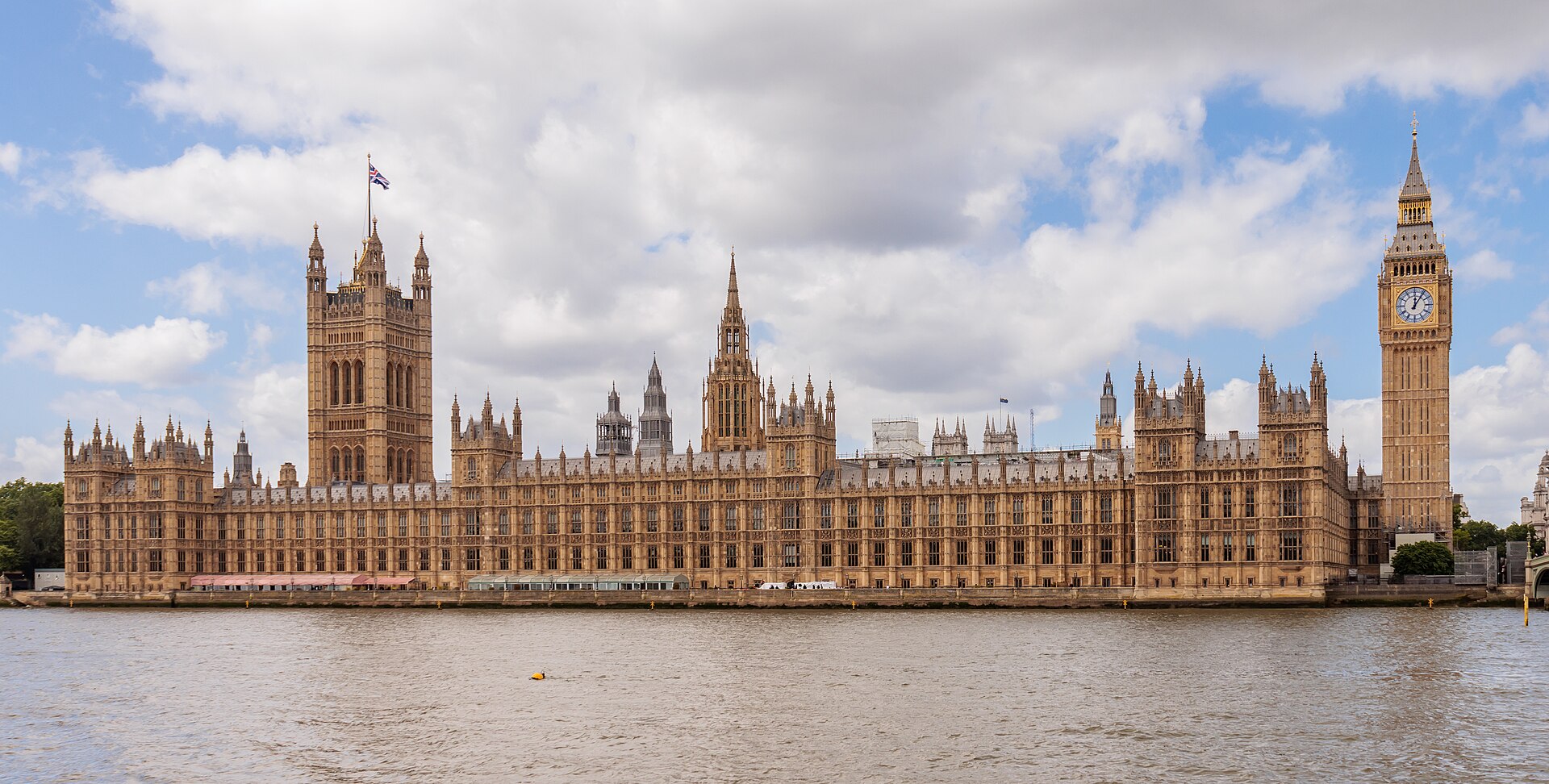
image for illustration: Palace of Westminster, Big Ben, and Westminster Bridge as seen from the south bank of the River Thames by Terry Ott, CC-BY-2.0 via Wikimedia Commons
Designing Buildings (DB) has summarised the history and outlined a future for the Palace of Westminster, as alternative takes on the options and plans highlight the complexity in an iconic project that is ‘owned’ by everyone.
DB writes:
…The Palace of Westminster, more commonly referred to as the Houses of Parliament, is the symbolic centre of political power in the United Kingdom and is one of the most recognisable and iconic buildings in the world. Sitting on the northern bank of the River Thames in London, it incorporates the House of Commons and the House of Lords which together act as the UK’s Parliament.
The building was designed according to the Gothic tradition by the architect Charles Barry together with Augustus Pugin, was constructed between 1840 and 1870. Perhaps its most iconic feature is the Elizabeth Tower, more famously known by the name of its bell, Big Ben. The Palace is a Grade I listed building and Westminster Abbey and St Margaret’s Church, have formed part of a UNESCO World Heritage Site since 1987.
The background
The restoration and renewal of the Palace of Westminster has been in discussion for many many years, with building said to be in dire need to upgrading. The last programme of major restoration being the stone cleaning and restoration programme that started in 1981, mainly focussing on the external facades which as been severely impacted by air pollution. After the construction of the new parliamentary building, Portcullis House was completed in 2000 the Restoration and Renewal (R&R) programme was established to start to look at a potential programme.
The preparatory work was more formally marked by the Parliamentary Buildings (Restoration and Renewal) Act 2019 which received Royal Assent on 8 October, 2019. The Act established the independent bodies, sponsor body and delivery authority who would be responsible for restoring the Palace of Westminster and managing its essential repairs and modernisation. The Act actually also mandated for a full decant of parliamentarians (ie moving both Houses out of the buildings) to speed up restoration, but the National Audit Office and Public Accounts Committee reviewed the project again in 2020 with the strategic review in 2021. A reassessment of the the plan, and subsequent proposals were published in 2022 and suggested changing the governance structure, including abolishing the original sponsor body. The new two-tier governance structure (Client Board and Program Board) was established in February 2023 with survey, design and alternatives progressing through 2024 and presented in 2025.
The costed proposals
This brings the project to its most recent iteration which was, on 5 February, 2026 the publication of the report ‘Delivering restoration and renewal of the Palace of Westminster: the costed proposals. This report sets the scene of the need for R&R through its introduction, outlining that the scope of works remain consistent through the different options and then routes to assessment of the options. It highlights that medieval elements of the building and its Victorian engineering services have not undergone a full renovation since just after the second World War and as such are failing. Safety is achieved by intensive maintenance, of day to day patching and mending which is increasingly unsustainable, costly and risky, with numerous fire, asbestos and stonemasonry incidents and very limited step?free access. As such delaying substantial work will rapidly increase costs, risks and operational disruption.
The report sets three main delivery options for the R&R Programme each expressing a different level of temporary relocation (or ‘decant’) from the Palace, with a detailed breakdown covering: Parliamentary business, cost, schedule, temporary accommodation, health, safety and fire considerations, security, disruption, accessibility, social value, heritage, environment and stakeholder views.
A full decant would see both Houses move out for most of the works; a continued presence option (which has now been now rejected) would have kept the Commons in the Palace with the Lords moving out; and an Enhanced Maintenance and Improvement (EMI) approach would phase works zone?by?zone so that no more than 30% of the building is decanted at a time. Within EMI, one variant seeks to keep both Chambers in place (also now discarded as being too slow, risky and expensive) while the EMI+ variant assumes a long decant for the Lords and a shorter one for the Commons, which would temporarily sit in the Lords Chamber. All options require substantial temporary accommodation on the Northern Estate for the Commons and, subject to agreement, use of the QEII Conference Centre for the Lords. Below is an extract of the table on page 14 ‘Summary information on the options’ showing just the cost elements of the different options.
Opportunities of the works
The Programme’s scope is described as ‘reasonably ambitious,’ aiming to achieve major improvements in fire safety, building services, asbestos removal, and conservation of the building fabric, alongside better accessibility and a permanent education centre. It is also framed as a national economic opportunity, expected to support between 1,500 and 4,000 full?time equivalent roles each year during construction and to create around 1,000 apprenticeships and traineeships.
Shortly after the release of the report the Electrical Contractors’ Association (ECA) was just one of the industry bodies seen to highlight the potential opportunities to its members in it article ‘Prestigious job opportunities ahead for contractors in Westminster restoration’. Saying ‘A new report from the Restoration and Renewal (R&R) Client Board detailing costed proposals for the restoration of the Palace of Westminster outlines a major pipeline of long-term opportunities for electrical contractors. The programme is expected to create significant future procurement opportunities over the coming years and ECA (Electrical Contractors’ Association) Members may be able to tender for work packages as the project progresses. ECA will provide further updates as more information is released.’
A way forward
After looking at each detailed breakdown the report concludes that full decant and EMI+ are the two most viable options. Full decant is shorter, less risky and lower?carbon risks overall, while EMI+ keeps more public access but takes longer and carries higher heritage and emissions risks.
Finally, the report sets out a proposed way forward centred on a ‘phase one’ package of works lasting up to seven years and costing up to £3 billion (excluding inflation). The first phase would fund resilience works (especially preparing temporary accommodation and fallback chambers), enabling works (such as early underground construction and temporary services), early restoration works (for example in Cloister Court and Victoria Tower), and detailed design and pre?construction planning. The intention being to reduce uncertainty and nugatory spending by developing only the full decant and EMI+ options further, with a final decision on one preferred delivery approach by around 2030 and the earliest decants starting in 2032. Members of both Houses are asked to reaffirm their commitment to restoring the Palace, authorise the phase one package, and support governance and legislative adjustments needed to oversee such a long, expensive and nationally significant programme.
Overall past, present and potential future timeline
- (2034: EMI+ Option: House of Commons (HoC) decants, zone by zone, to Northern Estate or elsewhere for 30-49 years, each zone being several years. Works complete: 2063-2086)
- (2032-2039: Full decant Option: phased decant of the HoC to Northern Estate for Chamber 8-10 yrs and HoC support functions 12-15 yrs) 2032: House of Lords decants to QEII 12-15 yrs. Works complete: 2045-2049)
- (2033: The end of the phase 1 works following 7 years)
- (2030: Final decision by Houses on the option employed and the extent of decant from the Palace)
- (2028 Palace town planning consents)
- (2027: Strategic Partner contract awards)
- 2026: Delivering restoration and renewal of the Palace of Westminster: the costed proposals published.
- 2025: R&R focus on critical, preparatory works, deep-ground investigations and structural assessments.
- 2024: R&R to develop three options to present in 2025, as surveying, design and remediation work progresses.
- 2023: A new two-tier governance structure (Client Board and Program Board) was established, with the ProgrammeBoard meeting for the first time in February 2023.
- 2022: Review completed and restructuring announced to replace the initial sponsor governing body.
- 2021: R&R focus on planning and assessments, safety risks, including fire hazards, asbestos, and failing infrastructure, with ongoing debates on the strategy carried out in both Houses during the year.
- 2020: National Audit Office reports and Public Accounts Committee review project.
- 2019: The Parliamentary Buildings (Restoration and Renewal) Act 2019 received Royal Assent.
- 2018: Major restoration of the Elizabeth Tower (Big Ben).
- 2017: Parliament decides in principle to proceed with a full restoration.
- 2016: Joint Committee report recommended a full decant
- 2015: Independent Options Appraisal published.
- 2013: Initial establishment of the Restoration and Renewal (R&R) programme.
- 2000 – Portcullis House completed. The new Parliamentary building was completed by M. Hopkins.
- 1990 – 1994: Restoration of the Victoria Tower, the tallest tower in the Palace.
- 1982 – 1990: Stone cleaning and restoration of north, west, south and River fronts.
- 1981 – 1982: Major stone cleaning and restoration programme starts with New Palace Yard.
- 1971 – Working group set up to offer advice on restoration as pollution taking its toll
- 1951 – The House of Lords returns to its Chamber.
- 1950 – The new Commons Chamber first used.
- 1948 – Foundation stone of new Commons Chamber laid.
- 1943 – Architect Sir Giles Gilbert Scott appointed for rebuild of chamber designed on similar lines to the old.
- 1941 – 1950: Rebuilding of the Commons Chamber following destruction in the Blitz.
- 1941 – The Commons Chamber destroyed on the last day of the Blitz
- 1936 – Scaffold for restoration of Victoria Tower, halted during the Second World War
- 1920 – Large fragment of stone falls from the Victoria Tower
- 1912 – Electric lighting installed in the House of Commons.
- 1883 – Electric lighting installed in the House of Lords.
- 1870 – The rebuilding of the Palace completed.
- 1860 – Victoria Tower completed.
- 1859 – Big Ben installed in the Clock Tower.
- 1852 – The Common’s Chamber completed.
- 1849 – Defects in the choice of stone became apparent, experiments with various compositions on stone
- 1847 – The Lord’s Chamber completed
- 1840–1870: Construction of the current Palace by Charles Barry after the 1834 fire.
- 1834 – The Great Fire destroys most of Palace
Related articles on Designing Buildings
- 10 Downing Street.
- 2020 IHBC Gus Astley Student Awards.
- Big Ben.
- City Hall, London.
- Demolishing Whitehall.
- Gothic revival style.
- Machicolation.
- Monument and context.
- Mr Barry’s War.
- Nineteenth century building types.
- Oxford Movement.
- Palace of Westminster.
- Parliamentary procedure.
- Redesigning parliament to help end the Brexit deadlock.
- Restoration and Renewal.
- Restoring the Palace of Westminster’s ventilation system.
- Scottish Parliament Building.
- St Paul’s Cathedral.
- Strawberry Hill House.
- The Story of Kensington Palace.
- US Capitol Building.
External links


