
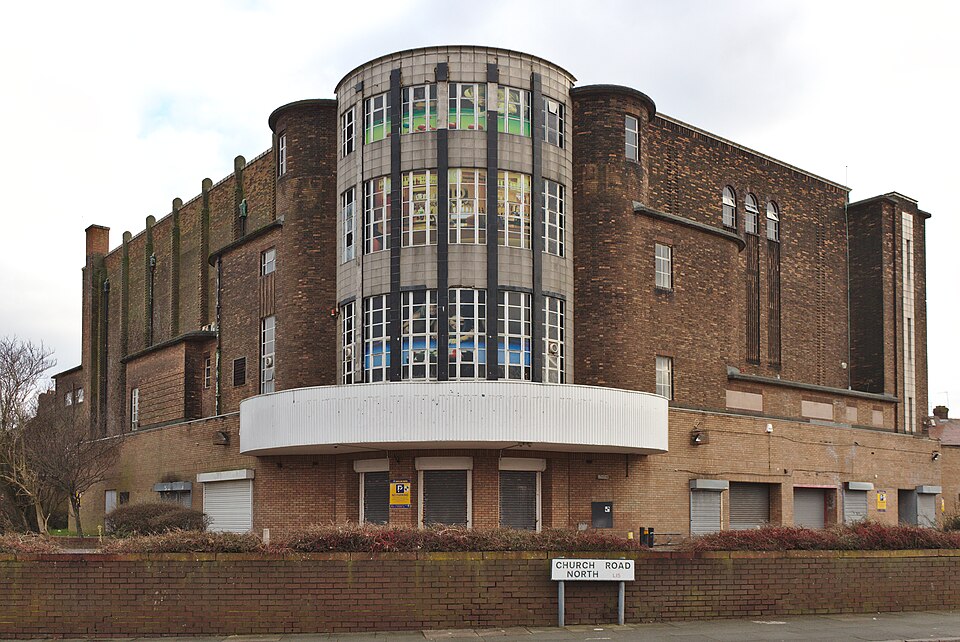
image for illustration: Former Abbey Cinema Wavertree – By Phil Nash from Wikimedia Commons CC BY-SA 4.0 & GFDLViews, Attribution, via Wikimedia Commons
Historic England has issued Kate Jordan’s Blog on how faith communities are bringing a new lease of life to former historic picture houses.
Historic England writes:
Cinemas were once a familiar feature of every high street. At their peak in 1946, an astonishing 4,709 cinemas were operating in Britain’s towns and cities. These dynamic buildings offered respite from the gloom of depression, wartime and rationing, beckoning audiences not only to watch films but also to marvel at the opulent interiors. Cinemas of the early to mid-20th century were designed to reflect the glamour of the movies. In shaping this new typology, architects drew freely from existing styles such as Art Deco and Neo-Gothic, experimented with exotic ‘Moorish’ and ‘Egyptian’ themes, and invented dramatic new vocabularies including the ‘Atmospheric’. In doing so, they created some of the most extraordinary interiors of the 20th century.
Sadly, the golden age of cinema construction was short-lived. From the 1950s, the popularity of television led to a decline in cinema-going, and by 1963, the number of operational cinemas had more than halved to 2,181.
From the 1980s, the advent of home videos accelerated the decline and this, combined with the shift to functional multiplexes, saw the closure of scores of 20th-century cinemas. By 2022 there were just 1,087 cinemas in operation in Britain.
Many cinema buildings were saved through reuse as nightclubs and bingo halls, but this frequently required destructive alterations such as the removal of fixed seating and raked flooring. By the 1980s, amenity societies such as the Cinema Theatre Association began to champion the cause of these buildings, resulting in the listing of many important examples. In the 21st century, former cinemas faced yet another threat, as the indoor smoking ban in 2007 led to the widespread closure of bingo halls. For the numerous empty cinemas, even listing couldn’t guarantee protection against neglect, vandalism and demolition.
In recent years, many of these buildings have found new life as places of worship, with religious communities restoring the buildings to their former glory. While former cinemas may seem an unusual venue for a church, mosque, gurdwara or temple, they are often ideally suited to worship. The spatial organisation of cinemas lends itself well to the performative style of worship in Pentecostal churches, where the stage provides a platform for musical services. In mosques, expansive auditoria can accommodate large numbers of worshippers for Friday prayers. In Hindu temples, the open spaces can accommodate free-standing shrines that worshippers process around. In gurdwaras, large rooms are often converted into dining halls and langar kitchens, which serve free food to the religious and local community.


