
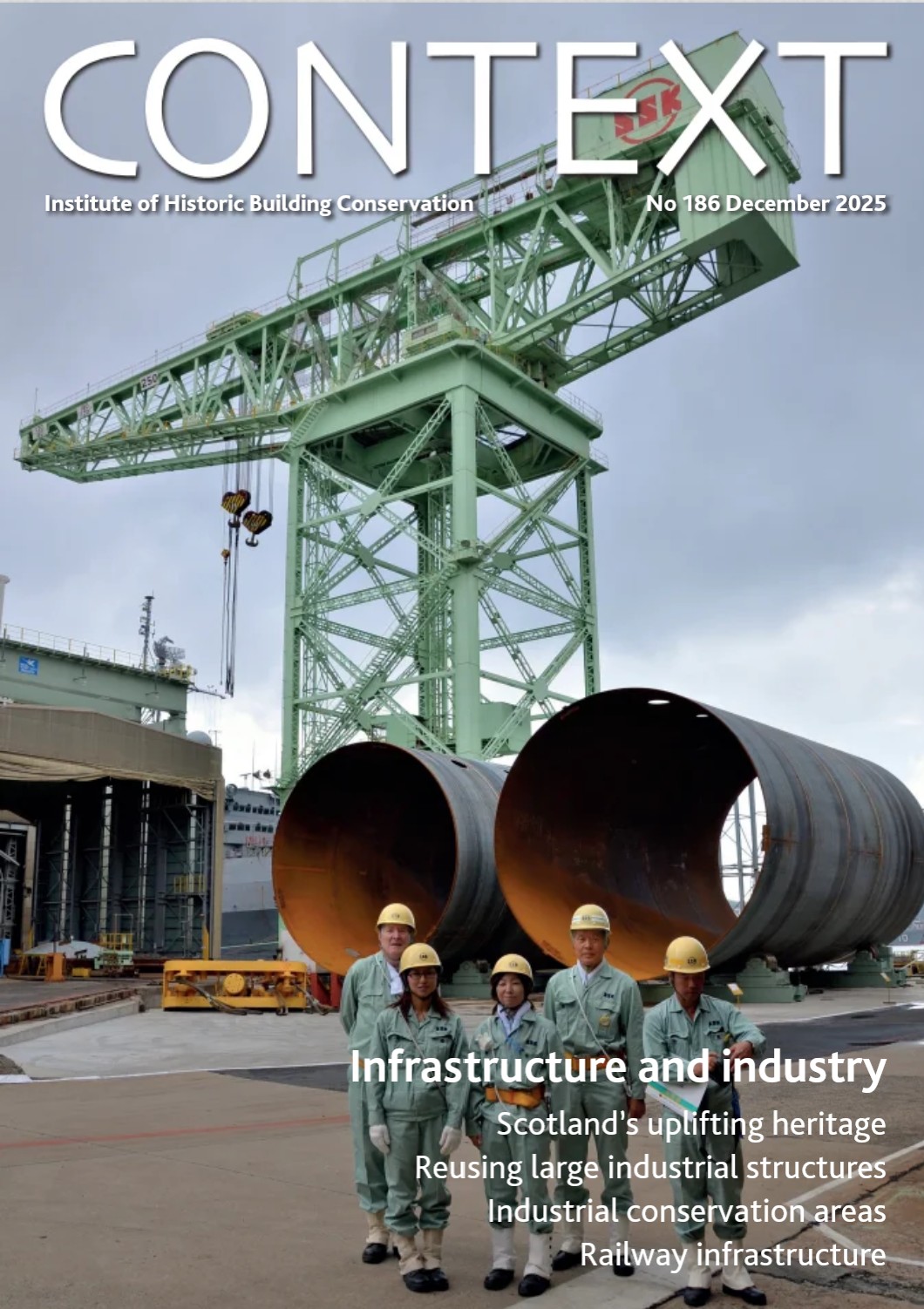
Bob Kindred’s ‘Periodically’, in IHBC’s new issue of its members’ journal Context – No. 186, themed on Infrastructure & Industry – offers ‘bite sized’ summaries from the best of current conservation and heritage periodicals and handbooks.
Bob Kindred writes:
The Historic Environment
In another wide-ranging, 170-page issue of The Historic Environment: policy and practice (Vol 16, No 2, 2025), of particular interest is a paper by Xiaohan Lu of the Mackintosh School of Architecture, Glasgow School of Art. Lu focuses on group value in the adaptive reuse of historic buildings, using case studies from the Merchant City, Glasgow. He highlights an issue regarding some properties in the Merchant City not qualifying for listed status in the past but then being protected shortly after they had been restored. This somewhat controversial phenomenon is seen as reflecting tensions inherent in legislation on the one hand with appropriate and sympathetic rehabilitation on the other.
…
Also from Turkey, Hatice Aysegül Demir and Hülya Yüceer of the department of conservation and restoration of cultural heritage at Izmir Institute of Technology have examined ‘New buildings in historic settings: revisiting Renzo Piano’s design approach’. This is a controversial issue involving a ‘starchitect’. The authors outline their review of the designs inserted into the historic environment to provide preliminary insights into design strategies. These have been adopted for recently completed Renzo Piano schemes for Paris, Valetta, Athens, Beirut and Istanbul, six of which are within the settings of Unesco world heritage sites. A seventh, set within a historic site in Beirut, is described individually to trace the architect’s design approach. Seven categories have been identified: the use of an existing square, the scale, form, view creation, transparency preferences, design openings and the colour choices that the authors consider Piano has found compatible with their historic settings. They suggest that these factors could form the basis for future policy guidelines regarding new buildings in historic urban settings, and they set these out in two tabular appendices.
Construction History
Hannah Kašpar contributes a paper in Construction History: the International Journal of the Construction History Society (Vol 40, No 1, 2025). Kašpar’s recent PhD at the University of Leeds focused on the Scottish neoclassical architects Robert and James Adam, exploring their subcontracting networks and supervision of building works. Her paper ‘From Quarry to Country House: Thomas Carter and the eighteenth-century Portland stone trade’ examines the trade networks and business practices of Thomas Carter the younger (c1720–95), a prosperous stonemason and merchant who managed a busy London workshop that specialised in chimney pieces, funeral monuments and other forms of architectural sculpture.
A paper by Tom F Peters of Lehigh University, Pennsylvania, deals with Louis-Joseph Vicat’s publications. Vicat’s role in the understanding of the hydraulic behaviour of cement is well known. His initial study of 1818 is recognised as an important step in the development of modern concrete and a seminal study in the development of the field of material science. The balance between science and empiricism facilitated the 19th-century pre-eminence of concrete construction in France. This can be traced to a hitherto unrecognised ‘virtual’ treatise reconstructed from Vicat’s 12 articles published between 1834 and 1846, combined with two rare volumes of statistics in 1839 and 1853. These, when taken together, show the scientific and statistical aspects of Vicat’s life, and how he combined analytical and empirical approaches to material study, providing a more complete picture of his role in the development of modern material science….
…
… SPAB Magazine
Mills News….
Context 186: CONTENTS
Regular & Occasional features & updates
- Briefing
- Out of Context
- Periodically
- The writer’s voice
- Letter
- Law and policy
Themed Articles
- Editorial
- The protection and reuse of large industrial structures, Peter de Figueiredo
- Historic England and infrastructure, Luke Wormald
- Reflections on railway heritage, Simon Hickman
- Scotland’s uplifting heritage, Miles Oglethorpe
- Power for the people, Wayne Cocroft
- Industrial heritage in the Ruhr, John Pendlebury
- Industrial conservation areas, Diane Harvey-White
Feature Articles
- Housing and heritage, Dave Chetwyn
- Celebrating brick gothic, David Andrews
IHBC Updates
- Notes from the chair
- New member profile
- New members
- Inter alia
- Vox pop
- Reviews
Commercial
- Products and services
- Specialist suppliers index
Reading Context helps IHBC members develop their skills across all of the IHBC’s Areas of Competence, and so is a critical baseline in addressing priorities in Continuing Professional Development (CPD)
Access the online archive and see the issue online
See more IHBC background and guidance on IHBC CPD and on how you might use past, current and future issues of Context
See the formal guidance paper on IHBC CPD (scheduled for update)
See more on the IHBC Competences and Areas of Competence


