
Historic England (HE) has posted its take on historic places in England connected with Irish communities.
Historic England writes:
St Patrick’s Day is a fixture in the British calendar, and while this celebration of Ireland’s patron saint may for some involve raising a pint or two of Guinness in a pub, there are many other places in England connected with Irish communities. In researching my book ‘Irish Emigration to England Explored Through Buildings’, I did visit a number of excellent pubs associated with the Irish. However, many different places that feature in it have strong ties to Irish culture and are equally worth visiting all year for their fantastic architecture.
St Joseph’s Church, Highgate, London
St Patrick is credited with establishing Christianity in Ireland, out of which the Catholic Church emerged. One of the most well-loved Catholic Churches in London is the Grade II* St Joseph’s in Highgate. Known to locals as ‘Holy Joe’s’, it has served Highgate since 1889. Although it was not purposefully built for Irish migrants, given that many lived in the area, historically it’s been well used by Irish worshippers. In 2024 the Irish were still the largest migrant group in Highgate with 4% of the population identifying as Irish, more than twice the London average of 1.8%. St Joseph’s was built by the architect Albert Vicars in a Neo-Romanesque style. Its white brick is now stained with years of pollution, but it is still impressive with its 2 tiers of windows. Its dome has an octagonal drum with pairs of round-arched windows set back under a segmental arch.
Our Lady Help of Christians, Birmingham
The Grade II* Our Lady Help of Christians in Kitts Green, Birmingham, is a wonderful example of a post-war church that has significant links to an Irish population. It serves the Chelmsley Wood estate, where many Irish migrants settled. It was designed by Richard Gilbert Scott of the esteemed architectural practice of Giles Scott, Son and Partner. Its distinctive ‘rib’ like vaulted concrete roof was innovative architectural engineering at the time. Inside, the impressive tent-style roof draws the visitor’s eyes to the colourful, and rare, stained glass windows created by the painter John Chrestien. His glass also fills the baptistry and Lady Chapel.
Bristol Hotel
Hospitality is a huge part of Irish culture, and many entrepreneurs in the industry have established businesses in England. The Bristol Hotel is part of The Doyle Collection, a hotel dynasty founded in 1959 by Pascal Vincent Doyle. The business is now headed by his daughter Bernie Gallagher, presiding over a portfolio of feted design and architecture-led hotels in both Ireland and the UK. This purpose-built Brutalist hotel and its adjacent car park were designed by the architects Kenneth Wakeford Jarram and Harris. When the buildings, located on Prince Street, opened in 1966, the hotel was called The Unicorn Hotel and the car park was meant to serve only hotel guests. The car park, with its distinctive geometric composition of X-components and V shaped supports, is now operated by NCP. Neither building is listed but are often cited as examples of significant mid-century design.
Herbert Art Gallery and Museum, Coventry
For a small country, Ireland’s output in the arts and culture is phenomenal. One of its beloved poets was also the first art director of Coventry’s Herbert Art Gallery and Museum. The Ulster-born poet and art reviewer John Hewitt was appointed to the role in 1957. The Herbert was the first modern art gallery to be opened in Britain following the Second World War and was conceived as an act of philanthropy by a wealthy industrialist, Sir Alfred Herbert. It was opened to the public in 1960. The original concept for the museum was a neo-classical design, but this was abandoned in favour of a post-modern style, drawn up by the Leicester architects Albert Herbert and Son. Its mid-century exterior is completed with carved friezes by the artist Walter Ritchie called ‘Man’s struggle’.
Hewitt and his wife Roberta arrived in Coventry at an exciting time in the city’s history. Post-war Coventry was booming, with further migration of Irish workers to assist with its rebuilding. According to the Coventry Irish Society, by 1961 there were 19,416 Irish-born people in the city, forming 6% of the population and making them the largest ethnic minority in the city at the time. Coventry still celebrates its Irish connections with events taking place across the city on March 17.
O’Sheas, Manchester
Historically March 17 was the date when Lenten restrictions on drinking alcohol were lifted and people would celebrate with a few drinks, which is apparently how pubs became associated with St Patrick’s Day. If you’re in Manchester, then head to O’Sheas, which is located in a Grade II* former shipping and packing warehouse called Lancaster House built for Lloyds Packing Warehouse Limited between 1905 and 1912 by the architect Harry S Fairhurst. It’s just a short walk from Oxford Street, which in the 19th century ran through a slum known as ‘Little Ireland’. The slum was demolished in 1877 in order to make way for the Manchester South Junction Railway line. The expansion of the railway gave rise to a number of businesses locating in the area, and the steel-framed Lancaster House, built in an Edwardian Baroque style, is just one of many surviving ornate former warehouses and offices. The entrance to O’Sheas, on Princess Street, is situated in a corner of the 7 storey Lancaster House, with a turret sitting atop the walls of brown and buff terracotta. It is not just its location that signifies its Irish connections, but its support for contemporary and traditional Irish music.
The White Swan, Birmingham
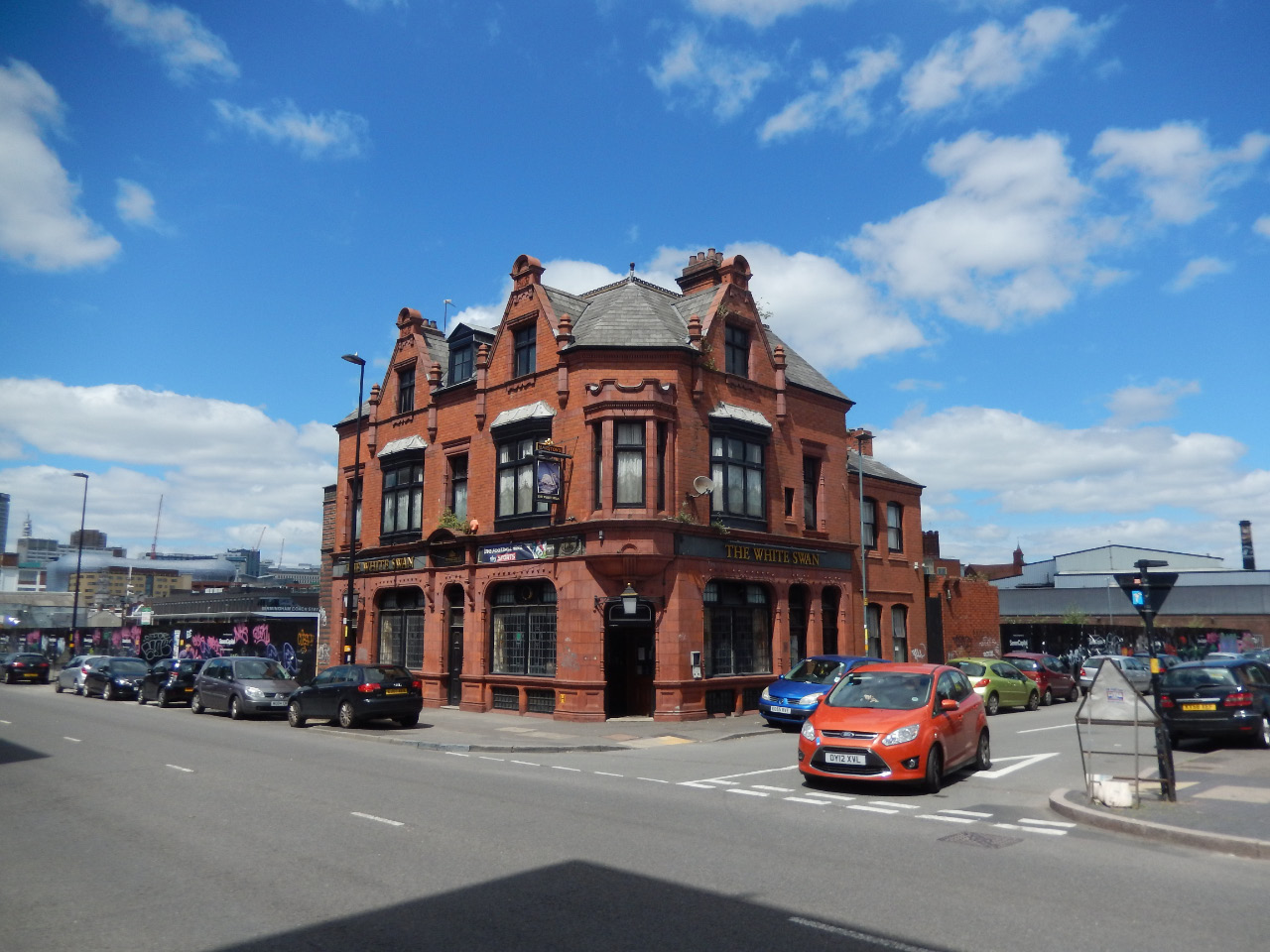
The Grade II White Swan, in Digbeth, is an example of how an English pub was adopted by the Irish. In 1969 a Roscommon couple, Michael and Agnes Creaton, took over the tenancy. Sadly, Michael died in 1975, but Agnes kept on the tenancy and then passed it to her daughter Angela, who ran the pub until 2019. When the Creaton family first took over the White Swan it had seen better days. However, this lack of investment meant its interior was left untouched. The pub boasts the best of the ‘gin palace’ décor, with pea green glazed Minton tiles lining the walls and forming friezes in the public bar, passages, stairs and outdoor. It was built in 1899 to 1900 by James and Lister Lea for Ansells Brewery. Its Gothic revival red brick and terracotta exterior is typical of pub architecture of the time. The pub retains almost all its original features.
Peter Kavanagh’s, Liverpool
The Grade II listed Peter Kavanagh’s pub, built in the 1840s, is named after its former owner, who purchased the premises in 1928. Peter Kavanagh, whose family had emigrated from Ireland, was a publican, politician, floral artist, fundraiser for the Catholic Church, and an inventor who patented a number of inventions, including a design for a tramcar, as well as tables and chairs. When Kavanagh purchased the freehold, he set about redesigning the interiors. He carved out 2 curved lounges from the space and designed them to be reminiscent of ships’ cabins, complete with paintings inspired by Hogarth and Dickens, painted by Eric Harold Macbeth Robinson. These rooms, and the wall murals depicting characters that were said to have been modelled on regular customers, are still in place. As are the special tables Kavanagh invented and patented in 1938, which included built-in ashtrays and hooks around the side for hats.


