
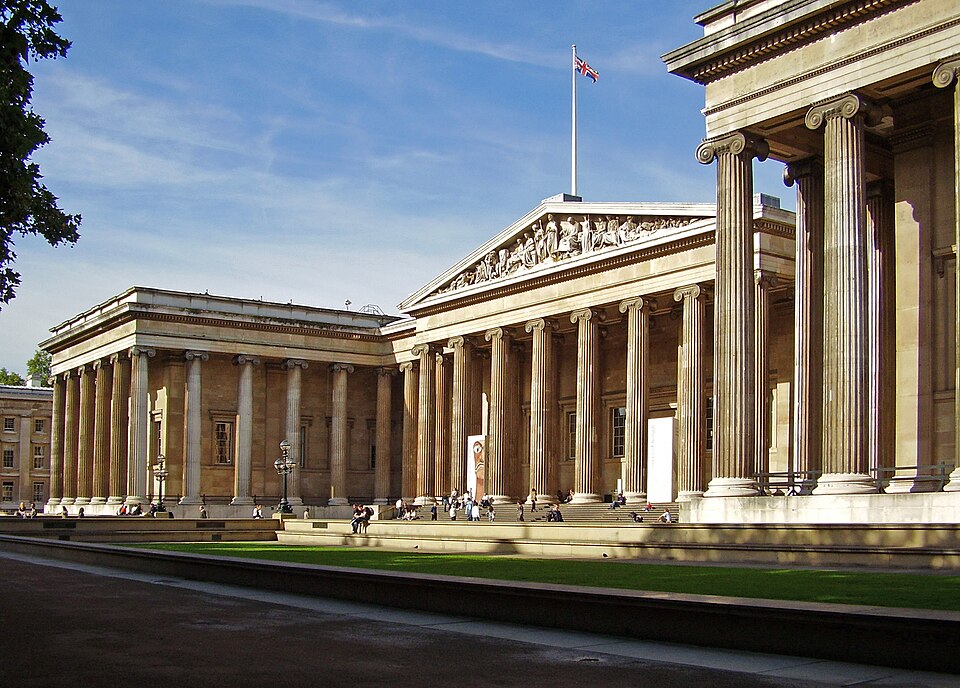
image for illustration: British Museum from NE, Ham, CC BY-SA 3.0, via Wikimedia Commons
The Georgian Group has formally objected and recommended refusal for the visitor pavilions in the forecourts of the British Museum.
The Georgian Group writes:
Applications for Planning Permission and Listed Building Consent have been submitted to Camden Council for the erection of two visitor welcome pavilions within the northern and southern forecourts of the British Museum. The proposals also include associated queuing and wayfinding infrastructure, railings, seating, and new landscaping to both forecourts. Consent is sought on a temporary basis for a period of up to ten years. Having carefully reviewed the applications, we have formally objected and recommended refusal. While we recognise the operational challenges faced by the Museum and the desire to improve visitor management and access, we consider that the proposals would cause an unacceptable level of harm to the significance of this internationally important site.
The British Museum is of exceptional architectural and historic interest. Designed by Sir Robert Smirke, one of the leading figures of the Greek Revival movement, its principal southern elevation to Great Russell Street represents the high point of Greek Revival architecture in Britain. The building’s monumental portico, symmetry, and formal composition are fundamental to its significance, as is its relationship with the forecourt, railings, and surrounding Bloomsbury townscape. Together, these elements form a highly coherent and carefully planned group which makes a major contribution to the character and appearance of the Bloomsbury Conservation Area.
The proposals involve replacing existing temporary structures with purpose-designed pavilions and introducing more informal landscaping to the forecourts. Minor amendments have been made following pre-application discussions, but we do not consider that these revisions adequately address our concerns. The proposed pavilion would partially obscure views of the southern elevation from Great Russell Street and within the forecourt itself, disrupting the building’s symmetry and undermining its setting.
We are concerned that the proposed informal landscaping would be visually incongruous in this highly formal and restrained setting. The forecourt was deliberately designed as a formal prelude to the grand portico and colonnade, and its clarity and symmetry are central to the experience and understanding of the building. In our view, the proposals would result in a high level of harm to the significance of the listed building, its setting, and the wider conservation area. We therefore consider that the statutory duties to preserve and enhance heritage assets have not been met and will continue to advocate for a more sensitive approach to this nationally important site.


