
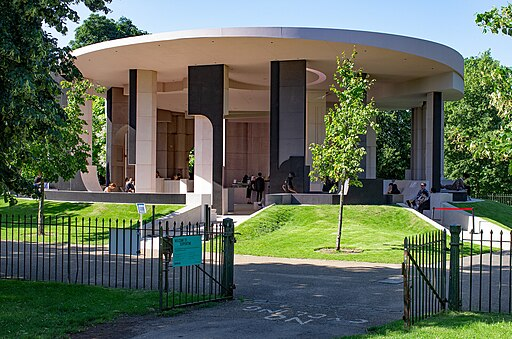
image for illustration: Hyde Park : temporary pavilion, Serpentine Gallery photo by Jim Osley, CC BY-SA 2.0, via Wikimedia Commons
Designing Buildings (DB), host platform to the IHBC’s Conservation Wiki, features ‘Temporary Structures’ in its Wiki-based resources.
Designing Buildings writes:
Any structure that is not designed for long-term use, but merely to serve some function in the short term, is temporary. At its most basic, a tent is a temporary structure, but it may also be a complete building that provides accommodation or storage, or it could be a form of structure or installation. Temporary structures are used widely across the UK for purposes ranging from construction and events to emergency response and industrial operations. Their popularity has grown due to advances in lightweight materials, modular systems, and off-site fabrication, which allow buildings to be assembled, dismantled, and reused efficiently. Modern temporary structures often employ modular construction, lightweight materials, and demountable connections to minimise waste and maximise reusability. Aluminium framing, tensile fabrics, and recycled plastics are commonly used for their strength-to-weight ratio and durability. Sustainability is an increasingly important consideration. Reusing temporary structures across multiple events or sites reduces the demand for new materials and lowers embodied carbon. Similarly, off-site manufacturing and rapid assembly techniques reduce disruption and improve safety on site.
Regulation
Schedule 2 of the Building Regulations 2010 defines a temporary building as ‘a building that is not intended to remain where it is erected for more than 28 days’. In some cases, temporary buildings may be exempt from certain building regulations, but this depends on their use, size, and proximity to other structures. The Town and Country Planning (General Permitted Development) Order 1995 defines a temporary use as one that does not exceed 28 days in any calendar year. This limit is reduced to 14 days for certain types of use, such as motor racing, clay pigeon shooting, or markets. Only specific temporary uses may be permitted without formal planning permission. Local planning authorities may require applications for larger or more complex temporary structures, particularly if they have a visual impact, generate significant traffic, or pose environmental concerns.
Functions of temporary structures
The term temporary structure can include a wide variety of buildings, ranging from small portable cabins to large-scale exhibition halls. They may be required to:
- Provide alternative accommodation during the refurbishment or reconstruction of a permanent building. For example, modular classrooms or offices may be installed on school or hospital grounds during redevelopment projects.
- Create signature or symbolic pavilions for special events such as trade fairs, festivals, or cultural exhibitions. A notable example is the annual Serpentine Pavilion in Hyde Park, London, which showcases innovative architectural designs using experimental materials and techniques.
- Provide temporary domestic or leisure accommodation, such as garden marquees, glamping pods, or event tents for private functions.
- Serve as welfare and operational facilities on construction sites, including site offices, canteens, drying rooms, and storage units. Portable buildings, such as Portacabins, are designed to be easily transported, stacked, and reused between sites.
- Mark historic or cultural milestones. Iconic structures such as the Millennium Dome (now The O? Arena) and the London Eye were both originally conceived as temporary installations for the year 2000. Their popularity and structural adaptability led to their conversion into permanent attractions.
- Support industrial or agricultural operations, such as lightweight, demountable buildings, modular canopies, or temporary steel-framed warehouses. These can be used to increase production or storage capacity without the cost or permanence of traditional construction.
See more on, and sign up to IHBC’s Conservation Wiki on Designing Buildings


