
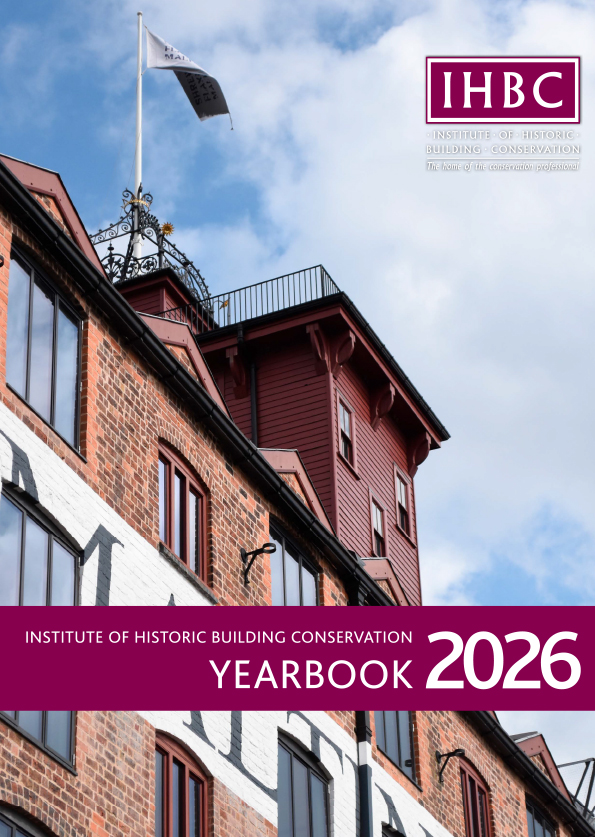
The IHBC’s 2026 Yearbook is our network’s essential sector guide, reference and review for 2026-27, complementing our 2026 Newcastle School, with IHBC updates and a foreword by Jan Bessell FRTPI, 2026 RTPI President, who supports ‘conservation planning’ as ‘… a creative, collaborative and cohesive force for good in the public interest’.
The IHBC writes:
Jan Bessel’s foreword to our 2026 ‘Yearbook’ argues that ‘conservation planning should not be seen as a remote, bureaucratic exercise, but as a creative, collaborative and cohesive force for good in the public interest…’.
Jan also confirms that: ‘The partnership between the IHBC and the RTPI is a great example of ‘planning across the divide’, as illustrated by recent collaborations… Tim Crawshaw… as the ‘Friend of the School’… and John Sturzaker… Director of Careers & Education contributing to a webinar looking at the skills needed for effective planning and conservation.’
Jan Bessell writes:
There a long history of planning and conservation professionals working together, and an equally long history of collaboration between the RTPI and the IHBC, so the opportunity to write this foreword is very timely as the two organisations renew and refresh their partnership. As I said in my inaugural speech as RTPI President, while the focus of discussions around planning often relate to the important systems and processes through which we plan areas and decisions are made, planning is about much more than that – it is an endeavour to answer one profound question: How do we want to live and thrive, while taking care of our environment and society in an equitable, accessible and productive way? The aspirations of the IHBC to think about conservation for people and places equally relates to that question, and to my main presidential theme: Planning with Purpose. The case studies in this yearbook provide powerful illustrations and compelling evidence of best practice and the outcomes good planning can achieve.
We should not underestimate the challenges inherent to this best practice: historic buildings and places which feature concentrations of such buildings are close to the hearts of the public, with heritage often reflecting shared memory, identity and continuity, helping communities feel rooted in place. Proposals for their adaptation and reuse are therefore often challenged. However, it is only with an eye on the future that we can be custodians of the best of the past, and the partnership between planning and conservation professionals is essential to that enduring continuity.
Conservation planning can be an enabler, a catalyst for regeneration, resilience, social cohesion and transformation, delivering new uses that move from cost centre to economic infrastructure. The expertise within our professions is deep and broad, but to build support and really engage we must be better at communicating: conservation planning should not be seen as a remote, bureaucratic exercise, but as a creative, collaborative and cohesive force for good in the public interest.
During my year as President, I’m supporting a new series of short films showcasing real places shaped by positive planning – tangible reminders of what the built and natural environment professions as well as communities can achieve when they work together.
The partnership between the IHBC and the RTPI is a great example of ‘planning across the divide’, as illustrated by recent collaborations: one of my predecessors as RTPI President, Tim Crawshaw, is acting as the ‘Friend of the School’ at the IHBC annual school 2026, and John Sturzaker our Director of Careers & Education is contributing to a webinar looking at the skills needed for effective planning and conservation.
Conservation planning isn’t about freezing places in time: it is about unlocking their future. Done well, it turns heritage into an asset for regeneration, builds resilience to climate and economic shocks, and strengthens the social fabric that makes places thrive. We can of course do more together to communicate these benefits and continue to celebrate the best outcomes that deliver economic resilience and growth, environmental stewardship and cultural value and identity of place. I therefore look forward to the relationship between the IHBC and the RTPI continuing to deliver and communicate these benefits and grow over the coming years.
Jan Bessell FRTPI is the 2026 President of the Royal Town Planning Institute
2026 YEARBOOK CONTENTS
Structure and Membership
- What is the IHBC?
- Structure of the IHBC
- Elected and appointed officers
- Branch areas
- Membership of the IHBC
Review and Analysis
- Foreword – Jan Bessell – President of the Royal Town Planning Institute
- Welcome – Rebecca Thompson, IHBC President
- Chairs’s Review – God is in the detail – David McDonald, IHBC Chair
- Director’s Update – Empowering Volunteers, Empowered by Volunteers – Sean O’Reilly, IHBC Director
Overview – Adaption and Change
- Sustainable Retrofit – Steve Berry
- Why All Regeneration Should be Heritage Led – Owen Barton
- Adapting Our Churches for Continued and Future Use – Martyn Jones
- Victorian Prisons – The Challenge of Adaption – Jonathan Taylor
- Adaptive Change and Transformation in Edinburgh – Terry Levinthal
Directory
- HESPR companies
- IHBC promotions and publications
- Directory of members
Useful Information
- IHBC-recognised courses
- RICHeS, Meggen Gondek
- National organisations
- Local authority contacts
- Products and services
- Specialist suppliers index
See the IHBC 2026 Yearbook HERE
See Yearbook Articles
See more on the IHBC’s Yearbook publications
See more background to the School at:
- As 90% of ‘Virtual’ Newcastle School feedback is ‘5/5’ or ‘4/5’, IHBC celebrates success in 2026, in learning, partnerships, friends & more, with thanks & congrats to all as Bristol 2027 looms, in June, on ‘Climate Change and Significance’
- IHBC & RTPI are 2026 Newcastle School ‘Friends’, sharing learning, CPD, support & more on ‘Adaptive Reuse’, as IHBC offers RTPI members IHBC-rates to our Virtual Day School on 19/06
IHBCs Yearbook: A note from 2026 for 2027
Since its launch in 2001, the IHBC Yearbook has grown from an 80-page publication to one of 120 pages today – our largest ever. Each edition includes a selection of articles supporting the theme of the Annual School, and the 2026 topic, the adaptive reuse of historic buildings, was ‘a particularly interesting one’, says co-editor Jonathan Taylor: ‘the topic raises a host of challenging issues, from sustainability and retrofit to the threat of redundancy, and this year we were delighted to welcome articles on a diverse range of topics from adapting churches in Wales to area-wide regeneration initiatives across the UK.’
On next year’s school topic, climate change and significance, Taylor finds himself working closely with his colleagues in IHBC’s South-West branch, as the 2027 event is to be held in Bath and Bristol, with a pre-school conference in Plymouth. ‘We all need to keep abreast of current developments in this fast-evolving field’ says Taylor. ‘Every day brings new interesting developments which will help us to reduce the impact of climate change on the historic environment and make it more resilient to the effects of extreme weather events.’ Alongside an exciting range of presentations and site visits, many of the most important issues will be explored in webinars and, of course, in the 2027 edition of the IHBC Yearbook itself.


