
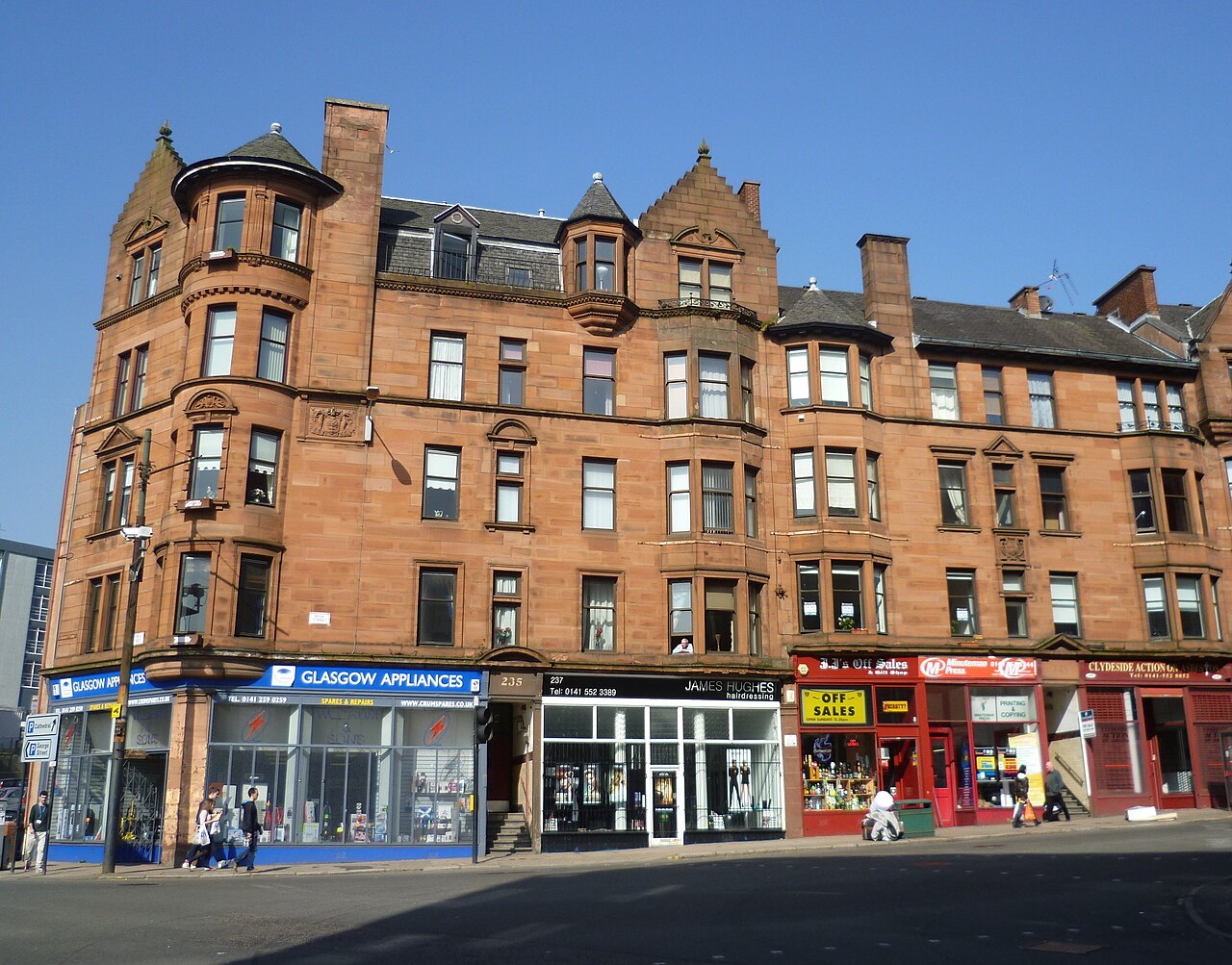
image for illustration: High Street tenements, Glasgow by Kim Traynor, CC BY-SA 3.0, via Wikimedia Commons
The National Trust for Scotland (NTS) is calling on all political parties in Scotland to commit to saving the nation’s built heritage as it says current Scottish and UK policies actively encourage the neglect and demolition of historic buildings, and that the public agrees this must change.
NTS writes:
Most restoration and renovation of existing buildings is subject to 20% VAT imposed by the UK Government, yet new builds (and demolition to make way for them) are zero-rated. This policy penalises the preservation, retrofitting and refitting of historically important and characterful buildings in our towns and cities, and in fact actually incentivises their disrepair and destruction.
In a ‘double whammy’ of policy failure, the ability to save and reuse built heritage is further compromised by acute labour and skills shortages, due to an absence of adequate government planning and support for vocational training. Addressing these matters is supported by the electorate: a survey we conducted in December 2025 showed that 58% of respondents wanted VAT relief to be applied to historic buildings as well as new builds, and 71% wanted increased investment in the skills required to preserve Scotland’s heritage.
The Trust’s Chief Executive, Phil Long OBE, said: ‘Current policies are far from being joined up and actually work against our built heritage, as we are seeing especially in Glasgow, where the degradation of some of the city’s finest historic buildings is appalling to see. That’s why the new intake of Scottish politicians must work with their counterparts at Westminster to address the anomalies and bring forth a wide range of benefits that we know the public wants.’ He said ‘Independent research has shown that a reduction or elimination of VAT on historic buildings would be offset by injecting £15 billion into the UK economy and the creation of 95,000 new jobs. At the same time, negating the unnecessary demolition of buildings that could be saved and brought back into use would stop enormous amounts of stored carbon – around 240,000 tonnes of CO² – being released into the atmosphere, thereby helping us to achieve vital net-zero targets.’
Diarmid Hearns, the Trust’s Director of Conservation and Policy, said: ‘There’s an urgent need for new housing and for buildings that are configured to adopt energy use that is sustainable and climate-friendly. Of course, new builds will play a part in addressing those requirements, but it seems needlessly myopic to ignore the fact that existing buildings are a necessary part of the equation. Almost 20% of the housing stock in Scotland was built before 1919; simply maintaining this requires a workforce with the skills to work with stone, slate and other traditional materials. That need, and the range of necessary specialist skills, multiplies when you also consider the many other public and private buildings that make up so much of the character of our towns and cities that are anything from 100–300 years old.’
Diarmid continued: ‘However, vocational and traditional skills training in Scotland has reached its nadir. Further Education colleges face chronic underfunding and some have dropped vocational courses, such as stonemasonry, altogether. We have to address this, not least because we are going to need people with these traditional buildings skills to retrofit older buildings for new heating systems and to ensure their survival in a wetter, stormier and warmer climate.’
Phil Long OBE Chief Executive added: ‘We are calling on all political parties and candidates to recognise the issues and to commit to changing these inadequate and contradictory policies. We also encourage the public to raise these issues with candidates on their doorsteps ahead of the May election. Righting these wrongs makes economic and environmental sense in the long run: not only do well-maintained historic buildings make our towns and cities better places to live, they also make a significant contribution to tourism. Tourists generate around £9.7 billion for Scotland each year, many of whom are attracted by our cultural and built heritage.’


